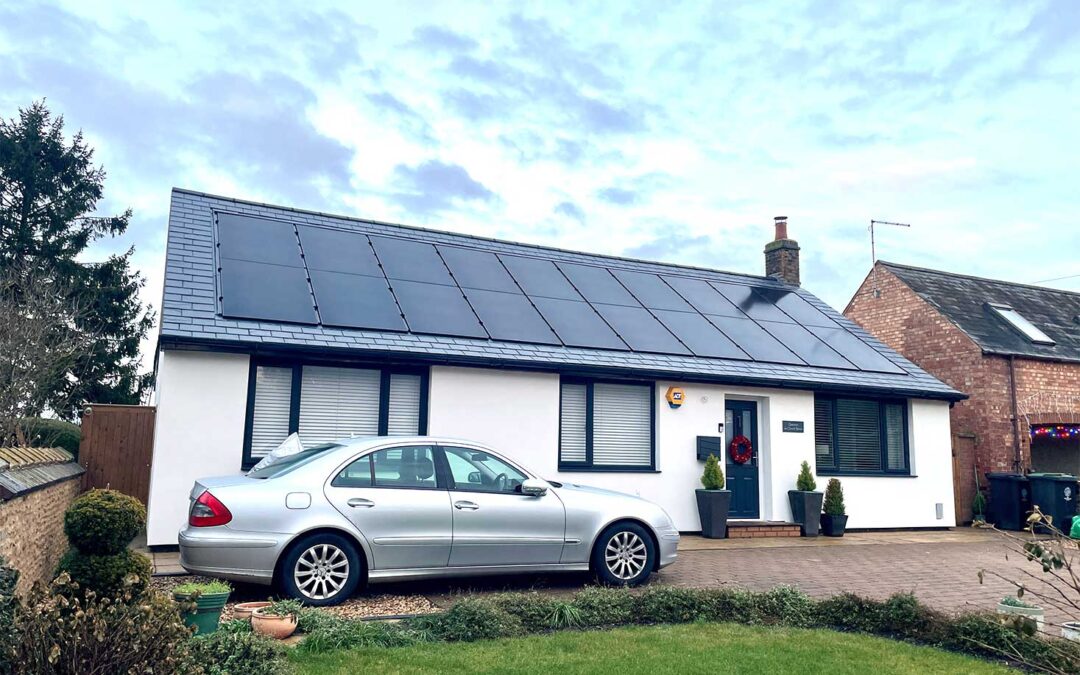
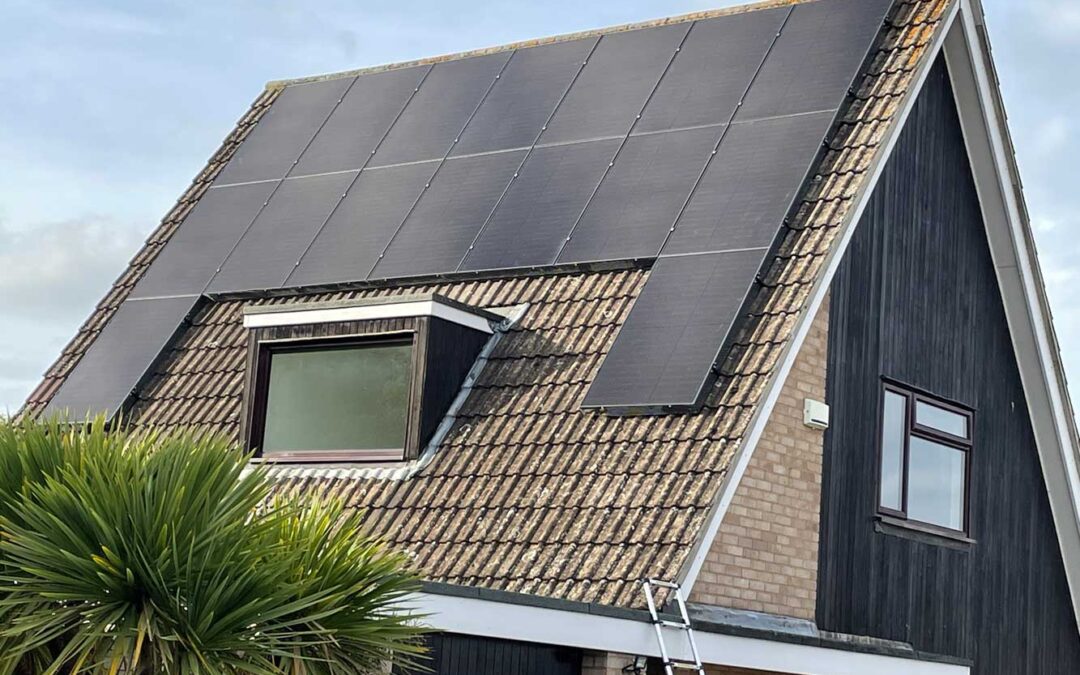
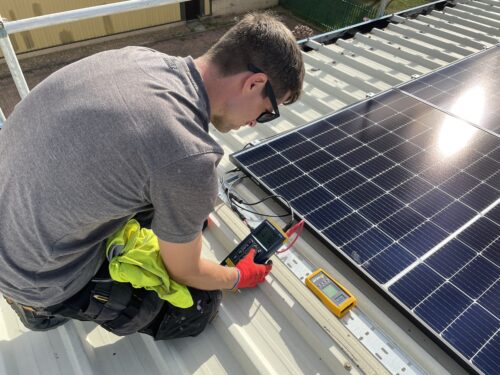
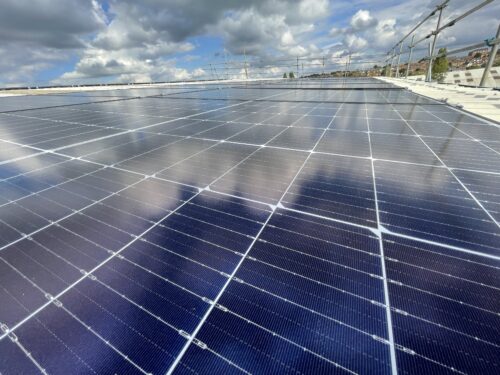
This install near Kettering has been turning heads since it was completed in September, as the final result means the roof is almost entirely occupied by solar panels. Having decided to go all electric with their energy the customer realised they could use the space on their roof to generate as much of their own power as possible and reduce their bills significantly. The result was just over 8kW of solar PV goodness covering around 90% of the area on the front roof, and it’s attracted quite a few compliments from passers-by as the flush-fit panels blend in perfectly with the welsh slate, giving the house a very modern and clean look that’s still in keeping with the original feel of the building.
In addition they opted for a 5.22kWh battery to store some of the power generated from the panels, as well as to store cheap rate power during the winter and use the battery to keep the house running at minimal cost. In the summer this system should produce considerably more energy than they need, and so they’ll be able to claim the Smart Export Guarantee (feed-in tariff) and get paid so should end up in credit with their supplier, further off-setting their bills in winter and saving them even more, so it’s a win-win…win.
A stunning Peterborough village was the location for this install, and the GSE flush-fit system was specified so as to be in-keeping with the aesthetic of this amazing barn conversion.
The customer chose a larger system with a battery to offset a higher-than-average demand, which is why it was decided to use three rooves, delivering a total output of a little over 7kW peak power, and the generation meets a good proportion of the energy needed. The battery can also be used to charge overnight on cheap rate power to allow for extra savings, especially in winter.
The install itself was pretty challenging given the multi-roof layout and cable routes, and the south facing array had some shading that was addressed with optimisers to make the most of the the morning sun, but the result was well worth the effort I’m sure you’ll agree…
Finding the Best Energy Tariff for Solar and Battery Owners
If you’ve invested in solar panels and battery storage, you’re probably looking to maximise your savings and make the most of your setup. The right energy tariff can make a big difference. Let’s break down the best options, focusing on those designed for households with solar and battery systems, and explain why Octopus Flux comes out on top.
1. Octopus Flux/Intelligent Octopus Flux: Tailored for Solar and Battery Owners
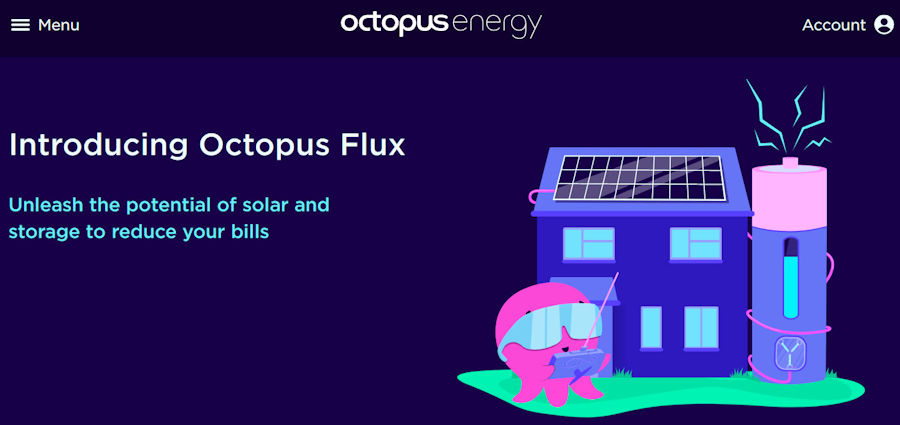
Octopus Flux is one of the most popular tariffs for people with solar panels and battery storage. It’s designed with time-of-use rates, meaning the cost of electricity changes throughout the day. You’ll pay lower rates during off-peak hours and can sell any excess energy back to the grid at higher rates during peak times.
Why it’s great:
You can charge your battery when electricity is cheap and use or export it when prices are high.
Export rates are very competitive, so you get a good return for your excess energy.
It integrates seamlessly with smart systems, helping you manage your energy use efficiently.
The downside:
The tariff works best if you have a flexible lifestyle or home automation, so you can align your usage with the pricing schedule.
It requires a smart meter, which might not be compatible with older systems.
Why it’s the top choice: Octopus Flux shines because it’s tailored for solar and battery users, offering significant financial benefits if you can adjust to its time-of-use model.
2. E.ON Next Solar Export Plan
E.ON Next offers a solar export tariff that pays you for the energy you send back to the grid. It’s straightforward and doesn’t depend on the time of day.
Why it’s good:
Simple and easy to understand—there are no peak or off-peak rates to worry about.
You’ll always know how much you’re getting paid for your exports.
The downside:
The export rate is fixed and lower compared to Octopus Flux, so you might not earn as much for your surplus energy.
It doesn’t reward shifting your energy usage to off-peak times, which could save you money on other tariffs.
Why Octopus Flux is better: With time-of-use rates, Octopus Flux gives you the opportunity to save money by being more strategic with your energy use, unlike E.ON’s flat-rate model.
3. British Gas PeakSave
British Gas PeakSave is another option worth considering. This tariff focuses on rewarding you for reducing energy use during peak times. It’s not exclusive to solar owners, but it can work alongside your setup.
Why it’s good:
If you can limit your energy use during peak hours, you’ll benefit from lower bills.
It’s great for people who don’t want to deal with exporting energy but still want to reduce costs.
The downside:
The rewards for reducing usage might not be as significant as earning higher export rates on other tariffs.
It doesn’t offer specific benefits for exporting your solar energy to the grid.
Why Octopus Flux is better: Octopus Flux rewards both smart energy usage and exporting surplus energy, making it a more comprehensive solution for solar and battery owners.
The Bottom Line
If you’re looking to get the most out of your solar and battery setup, Octopus Flux is the best tariff on the market. Its time-of-use rates and competitive export payments put you in control, letting you save more and earn more. Octopus Energy offer all sorts of tariffs to suit different customers with EV’s, solar, solar and battery, all or none of the above and more, but which one is best if you have solar and battery. Their range of tariffs can be confusing, but in our opinion if you have both solar generation and battery storage Octopus Flux is the best option right now*, so here’s a brief summary of what it is and if you switch to Octopus from another supplier using this link you’ll receive £50 towards your first energy bill, and we’ll receive a £50 referral bonus. We have set up a referral link off the back of this simply being the best option right now, because our team use Octopus ourselves after a lot of research!
So now we’ve assessed which is the best tariff for solar and battery owners, let’s dig into what Octopus Flux is in more detail.
Image by Gazi Jamal Uddin from Pixabay
What Is Octopus Flux?
Octopus Flux is a smart, 3-rate electricity tariff combining import and export. The symmetrical import/export tariffs have three pricing periods throughout the day. Octo Flux is a flexible tariff, so unit rates and standing charges can change with wholesale energy prices, but you’ll always receive reasonable notice of any price changes and can switch tariff or change provider at any time without penalty. There are no exit fees or tie-in periods.
What’s The Benefit Of Octopus Flux?
You can top up your battery overnight in the 3-hour cheap period and discharge your battery in the 3-hour peak period and export any surplus energy back to the grid at the optimum time.
The Flux rate (cheap period) is 02:00-05:00 every day and around 20.4p/kWh for electricity imported, depending on your location. You’ll receive around 9.4p/kWh for exports during this time. The peak rate is 16:00-19:00 and prices are around 47.5p/kWh and 36.5p/kWh for imports and exports respectively, again with small regional variations. The day rate is all other times and is around 34p/kWh for imports and 23p/kWh for exports. There is a daily standing charge of 45p.
So I Need Solar Panels?
Yes, but any supplier can have installed them, not only Octopus. If you’re presently getting solar panels installed, you can still switch to Octopus Flux. Octopus will require a copy of your MCS certificate for your solar installation and a copy of a letter or email confirming that your local energy network was notified of your installation. Your system must have a maximum generation of 9kWp.
Do I Need A Smart Meter For Octopus Flux?
Yes. For billing purposes Octopus need to be able to receive your electricity readings every 30 minutes. You need to have a SMETS2 or Secure brand SMETS1 smart meter. If that isn’t the case, Octopus can install a smart meter free of charge.
Will I Lose My Feed-In Tariff On My Existing Solar System?
You don’t need to switch your FiT contract to Octopus and if you move to Octopus Flux you won’t lose your generation tariff. You will however have to permanently opt-out of your deemed export payments. You’ll receive the Octopus Flux export rate for your region instead. Should you leave Octopus Flux and/or Octopus itself, your generation tariff won’t change and your export tariff will then be the Smart Export Guarantee (SEG) rate of your new tariff/new provider.
Is There A Limit To How Much Electricity I Can Export?
No, but the maximum output from your solar system will be restricted according to the limit of the breaker in your home, which is usually between 40 and 100 amps.
How Do I Sign Up To Octopus Flux?
Firstly you have to be an Octopus Energy customer. If you’re just joining Octopus you’ll be placed on an standard tariff for a short period while Octopus connect to your smart meter.
*Tariffs are changing all the time and this is the information we have right now, but you must check with Octopus before you switch to make sure the details are still correct and that this is the best tariff for you.
What are the other tariffs Octopus offer?
Given Octopus’ excellent reputation for tariffs tailored for solar and battery users, we thought it would be useful to outline the other options they offer. Below see all the Octopus tariffs, ranked from top to bottom showing at the top the best ones for solar and battery owners.
Joint No. 1. Intelligent Octopus Flux – The Best Option for Maximum Efficiency
This tariff is specifically tailored for homes with solar and battery systems. It uses smart technology to automate your energy storage and usage for optimal savings. The off-peak window lasts 21 hours, and during these times, electricity rates are significantly reduced compared to their standard tariffs. Between 4 pm and 7 pm—the peak window—you’ll get excellent rates for exporting stored energy back to the grid.
Joint No. 1. Octopus Flux – Ideal for Hands-On Energy Management
This option works well for those who don’t mind manually managing their energy use and battery. Like Intelligent Octopus Flux, it offers a cheap rate for charging your battery during the early hours and pays a higher export rate during peak times. The key difference is that this plan doesn’t automate energy management, so you’ll need to monitor and control your system.
2. Octopus Agile – Best for Flexible Energy Use
Octopus Agile is a half-hourly pricing tariff that reflects the wholesale cost of electricity. Prices can drop to extremely low levels during times of low demand, which can be advantageous for charging your battery. However, it requires active monitoring to make the most of it.
3. Octopus Go – Suitable for EV Owners with Solar Systems
Originally designed for electric vehicle users, this tariff offers cheap electricity during a set night-time window. It can be a decent option for solar and battery owners who want to charge their batteries at night, but it doesn’t provide high export rates or solar-specific benefits.
4. Flexible Octopus – A Basic Option for Simplicity
This is Octopus Energy’s standard variable tariff. While it offers flexibility with no exit fees, it doesn’t provide any specific advantages for solar and battery users.
Why Octopus Flux / Intelligent Octopus Flux is the Best Choice
While all these tariffs have their merits, Octopus Flux and Intelligent Octopus Flux lead the pack. For those that have a set up that works with Intelligent’s tech, we would go for this as its combination of automation, long off-peak hours, and excellent export rates make it the ultimate choice for solar and battery owners who want to optimise savings with minimal hassle. However if you don’t have a compatible setup Octopus Flux will help you get the most bang for your buck for your solar and batteries.
Choosing the right one for you
The best thing when choosing your tariff is to assess your energy habits, and choose the option that aligns best with your lifestyle. We hope you found this article helpful in your journey and if you are interested in getting solar or batteries, please get in touch. If you have solar and batteries, have you considered running your car or vehicle off the sun? Home EV chargers mean you can charge your car for pennies, whilst helping save the planet to by burning less costly fossil fuels – it’s a win-win!
An unusual roof and a steep pitch meant that this 6kW south-facing install was a little different to the norm, but the result is a system that produces tons of power even on a sunny December day. In fact the low winter sun hits these panels at just the right angle, so even in the depths of winter it’s capable of generating several kilowatts of power and enough to fill a 5kWh battery whilst also powering the house. You could say it’s a literal ‘powerhouse’…ahem.
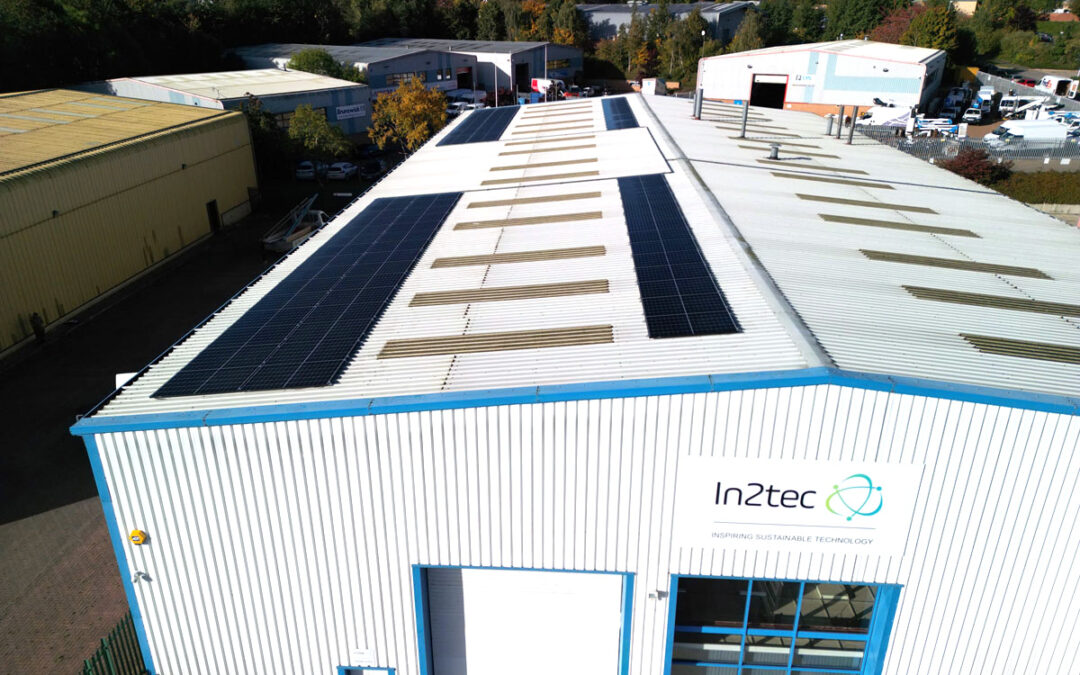
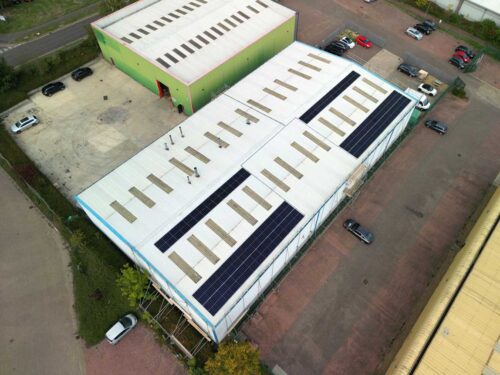
This industrial install was super fun and should help the customer power their unit and charge their EV’s. At 36kW it’s a substantial system, but there’s room for even more generation should they decide it’s needed. Either way the amount of power they’ll need from the grid will be minimised, and their bills will drop from day one. See the video and click on the images below to get a closer look.