


Working out how many solar panels you need is one of the first steps in planning a solar installation. The right system size depends on your energy usage, available roof space, panel efficiency and your long-term goals. Below is a straightforward guide to help you understand what affects system size and how to calculate an estimate for your property.
1. Start with your annual electricity usage
Your latest electricity bill will show your annual consumption in kilowatt hours. Most UK households fall between 2,700 and 4,500 kWh per year, although larger homes or those with high-use appliances can sit far above this range.
As a quick reference:
-
Low-use home: around 2,000 to 2,500 kWh
-
Average home: around 3,000 to 4,000 kWh
-
High-use home: 4,500 kWh or more
-
Small business: often 6,000 kWh to 20,000 kWh depending on operations
You cannot size a system accurately without knowing this figure.
2. Understand what a typical solar panel produces
Modern domestic solar panels usually sit between 380 W and 450 W per panel. We generally use 440W panels. You can get panels with larger wattage, but they are simply bigger.
A single 400 W panel in the UK generates roughly 350 to 450 kWh per year, depending on roof direction, shading and local weather. South-facing roofs produce the highest yields, while east and west still perform well.
If you need 4,000 kWh annually, and one panel produces around 400 kWh per year, you would need about 10 panels.
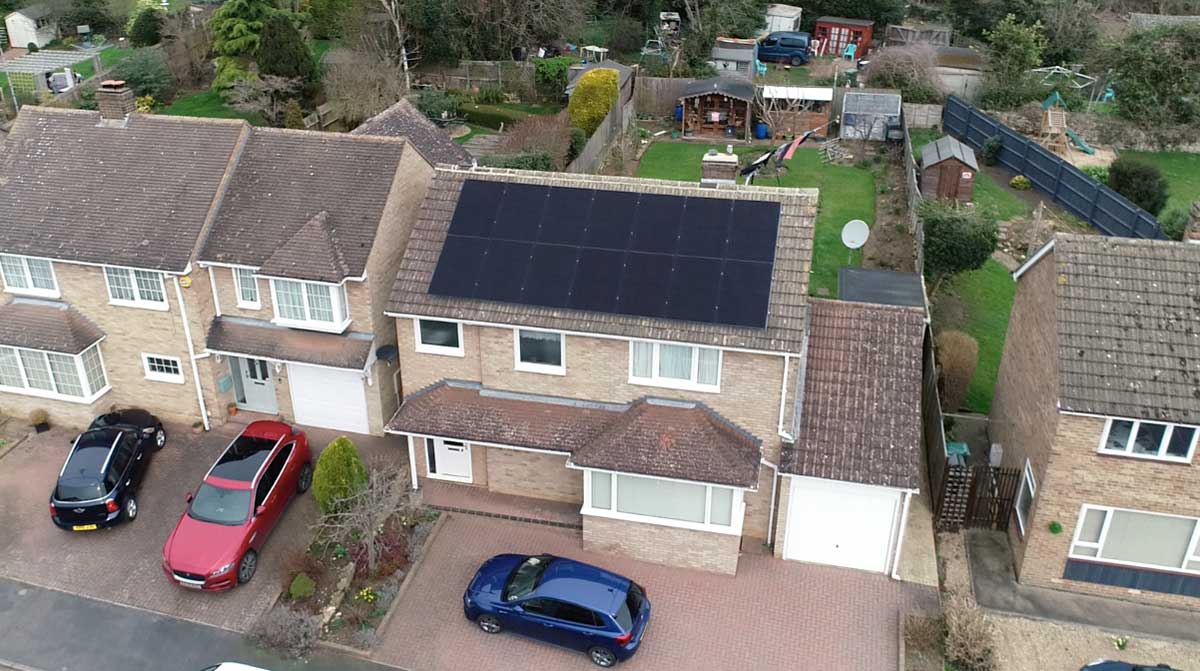
Solar panels on a GENR8 house installation in Northamptonshire; a large roof means they could fit 14 panels
3. Use this simple formula
Number of panels = Annual electricity usage (kWh) divided by annual output per panel (kWh)
For example:
-
Your usage: 3,600 kWh per year
-
Estimated output per panel: 400 kWh per year
-
Calculation: 3,600 ÷ 400 = 9 panels
Most UK homes end up with 10 to 14 panels, depending on roof size and energy needs.
4. Check your available roof space
A standard solar panel is about 1.7 m by 1.1 m, so roughly 1.9 m².
You will need:
-
10 panels: about 19 m²
-
14 panels: about 26 m²
-
20 panels: about 38 m²
If your roof is smaller, shading is an issue, or you want to keep costs down, you may choose a slightly smaller system. If you plan to add an electric vehicle or heat pump in future, you may opt for a larger array.
5. Consider your goals
Your ideal system size also depends on what you want from the installation:
Reduce bills as much as possible
Aim to match most of your annual usage. This usually leads to a 4 kW to 6 kW system for a typical home.
Become more self-sufficient
Pair a slightly larger array with a battery. This reduces reliance on the grid in winter and stores surplus power in summer.
Prepare for an EV or heat pump
Future electrification increases demand, so installing extra capacity now can save money later.
Meet CSR and sustainability goals (businesses)
Commercial rooftops often hold large arrays. Even a medium unit can support 30 kW to 200 kW, with significant bill reduction.
6. Real examples for typical UK homes
Two-bed home with average usage
Annual usage: 2,700 kWh
Panels needed: 7 to 8
Typical system size: 3 kW
Three-bed semi-detached
Annual usage: 3,500 to 4,000 kWh
Panels needed: 9 to 12
Typical system size: 4 to 5 kW
Four-bed detached with high usage
Annual usage: 5,000 to 6,000 kWh
Panels needed: 12 to 16
Typical system size: 5 to 6.5 kW
Small business unit
Annual usage: 10,000 to 20,000 kWh
Panels needed: 25 to 50
Typical system size: 10 to 20 kW
7. Other factors that influence how many panels you need
-
Roof direction: south gives the highest output, east or west slightly less
-
Shading: nearby trees or buildings reduce efficiency
-
Panel efficiency: modern panels produce more power per square metre
-
Local climate: southern England produces slightly higher yields than northern regions
-
Inverter size: your inverter should match your panel capacity
-
Battery storage: affects how much self-consumption you can achieve
8. In summary
If you are asking “how many solar panels do I need”, you can get a good estimate by checking your annual electricity usage, dividing it by the typical output per panel and checking how much roof space you have. Most homes need between 8 and 14 panels, while businesses may need far more depending on their building size and energy demand.
If you want to know how many panels you can fit on your roof, email us today with your address and we can do you an instant quote.
0 Comments