by Emily Fedorowycz | Jan 12, 2026 | Uncategorized
Working out how many solar panels you need is one of the first steps in planning a solar installation. The right system size depends on your energy usage, available roof space, panel efficiency and your long-term goals. Below is a straightforward guide to help you understand what affects system size and how to calculate an estimate for your property.
1. Start with your annual electricity usage
Your latest electricity bill will show your annual consumption in kilowatt hours. Most UK households fall between 2,700 and 4,500 kWh per year, although larger homes or those with high-use appliances can sit far above this range.
As a quick reference:
-
Low-use home: around 2,000 to 2,500 kWh
-
Average home: around 3,000 to 4,000 kWh
-
High-use home: 4,500 kWh or more
-
Small business: often 6,000 kWh to 20,000 kWh depending on operations
You cannot size a system accurately without knowing this figure.
2. Understand what a typical solar panel produces
Modern domestic solar panels usually sit between 380 W and 450 W per panel. We generally use 440W panels. You can get panels with larger wattage, but they are simply bigger.
A single 400 W panel in the UK generates roughly 350 to 450 kWh per year, depending on roof direction, shading and local weather. South-facing roofs produce the highest yields, while east and west still perform well.
If you need 4,000 kWh annually, and one panel produces around 400 kWh per year, you would need about 10 panels.
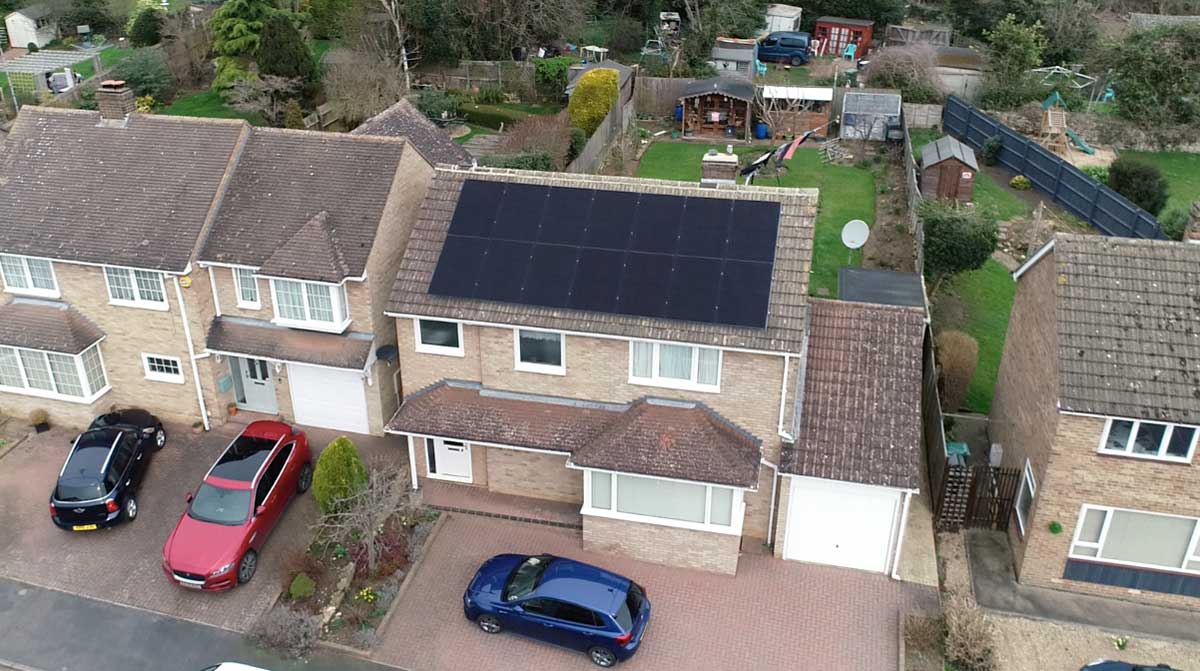
Solar panels on a GENR8 house installation in Northamptonshire; a large roof means they could fit 14 panels
3. Use this simple formula
Number of panels = Annual electricity usage (kWh) divided by annual output per panel (kWh)
For example:
-
Your usage: 3,600 kWh per year
-
Estimated output per panel: 400 kWh per year
-
Calculation: 3,600 ÷ 400 = 9 panels
Most UK homes end up with 10 to 14 panels, depending on roof size and energy needs.
4. Check your available roof space
A standard solar panel is about 1.7 m by 1.1 m, so roughly 1.9 m².
You will need:
-
10 panels: about 19 m²
-
14 panels: about 26 m²
-
20 panels: about 38 m²
If your roof is smaller, shading is an issue, or you want to keep costs down, you may choose a slightly smaller system. If you plan to add an electric vehicle or heat pump in future, you may opt for a larger array.
5. Consider your goals
Your ideal system size also depends on what you want from the installation:
Reduce bills as much as possible
Aim to match most of your annual usage. This usually leads to a 4 kW to 6 kW system for a typical home.
Become more self-sufficient
Pair a slightly larger array with a battery. This reduces reliance on the grid in winter and stores surplus power in summer.
Prepare for an EV or heat pump
Future electrification increases demand, so installing extra capacity now can save money later.
Meet CSR and sustainability goals (businesses)
Commercial rooftops often hold large arrays. Even a medium unit can support 30 kW to 200 kW, with significant bill reduction.
6. Real examples for typical UK homes
Two-bed home with average usage
Annual usage: 2,700 kWh
Panels needed: 7 to 8
Typical system size: 3 kW
Three-bed semi-detached
Annual usage: 3,500 to 4,000 kWh
Panels needed: 9 to 12
Typical system size: 4 to 5 kW
Four-bed detached with high usage
Annual usage: 5,000 to 6,000 kWh
Panels needed: 12 to 16
Typical system size: 5 to 6.5 kW
Small business unit
Annual usage: 10,000 to 20,000 kWh
Panels needed: 25 to 50
Typical system size: 10 to 20 kW
7. Other factors that influence how many panels you need
-
Roof direction: south gives the highest output, east or west slightly less
-
Shading: nearby trees or buildings reduce efficiency
-
Panel efficiency: modern panels produce more power per square metre
-
Local climate: southern England produces slightly higher yields than northern regions
-
Inverter size: your inverter should match your panel capacity
-
Battery storage: affects how much self-consumption you can achieve
8. In summary
If you are asking “how many solar panels do I need”, you can get a good estimate by checking your annual electricity usage, dividing it by the typical output per panel and checking how much roof space you have. Most homes need between 8 and 14 panels, while businesses may need far more depending on their building size and energy demand.
If you want to know how many panels you can fit on your roof, email us today with your address and we can do you an instant quote.
by Emily Fedorowycz | Dec 3, 2025 | Solar
Solar power continues to grow in popularity across the UK, and it is easy to see why. The technology has matured, costs have fallen, and both households and organisations are increasingly seeking cleaner, more reliable ways to power their buildings. This guide provides a clear and balanced overview of the advantages and disadvantages of solar panels, drawing on the experience and insight that we can share as a solar specialist.
One big takeaway though, is that broadly speaking if you are in your home or commercial property for the next 5 years, then solar is a worthwhile investment.
Advantages of solar panels
1. Renewable and abundant
Solar energy is one of the cleanest and most sustainable power sources available. The sun provides a vast supply of energy every day, making it a dependable long-term solution for homes and businesses working to reduce carbon emissions.
2. Lower electricity bills
Generating electricity on site reduces reliance on the grid, leading to substantial savings over the lifetime of a solar system. Panels help shield properties from rising energy prices, offering long-term financial stability.
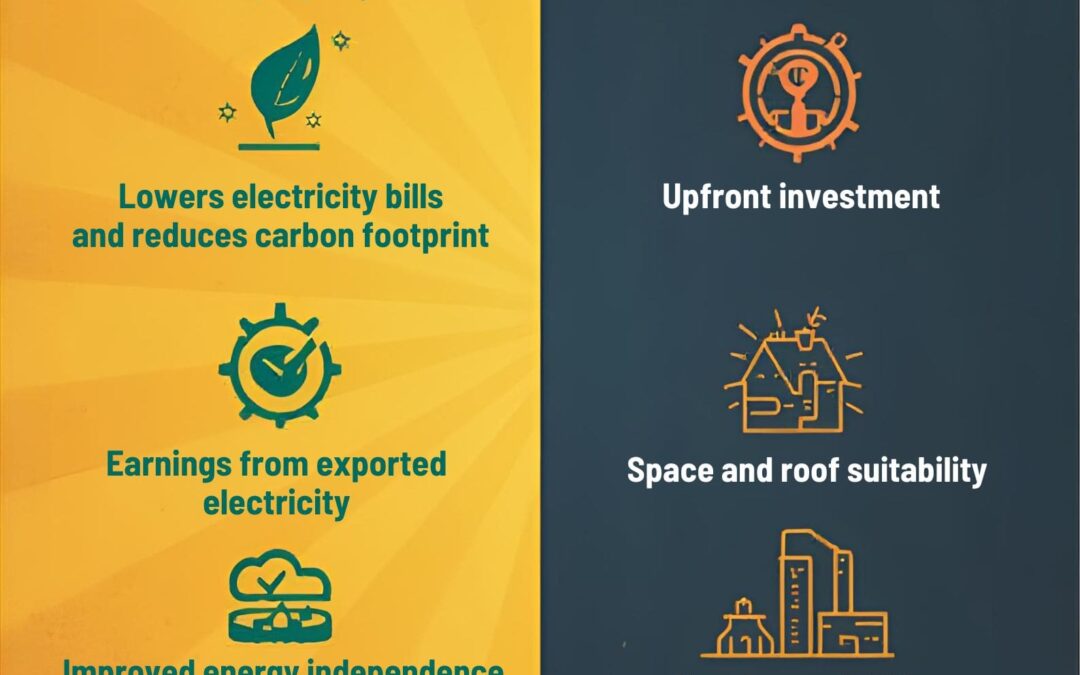
3. Earnings from exported electricity
When a system produces more electricity than is used, the surplus can be exported back to the grid. The UK’s Smart Export Guarantee provides payments for this exported energy, improving the overall return on investment.
4. Diverse applications
Solar technology is highly versatile. Panels can generate electricity, support heating systems through solar thermal, and be integrated into different building materials. This flexibility makes solar suitable for a wide range of property types.
5. Low maintenance and long lifespan
Solar panels contain no moving parts and require minimal upkeep. Most systems operate efficiently for 25 years or more, supported by long manufacturer warranties and straightforward maintenance routines.
6. Rapid technological progress
Improving panel efficiency, smarter inverters and more competitive pricing have made solar systems more effective than ever. These advances allow modern installations to deliver stronger performance even in challenging conditions.
7. Improved energy independence
By pairing panels with battery storage, properties can store surplus energy for use later in the day. This reduces exposure to grid fluctuations and helps maintain a steady supply during peak times or power cuts.
8. Enhanced property appeal
Buildings with solar installations often attract buyers, tenants or clients due to their lower running costs and strong sustainability credentials. Solar is widely viewed as a forward-thinking asset that adds value.
9. Works in varied weather
Modern photovoltaic panels generate power even on cloudy days, which makes them especially well suited to the British climate. Although output is highest in direct sunlight, useful energy is still produced year-round.
Disadvantages of solar panels
1. Upfront investment
Despite falling prices, a solar installation still requires a significant initial outlay. Pay-back periods vary depending on usage, system size and export income, typically taking several years to realise full cost recovery. For domestic homeowners there is not much support available to help with this initial cost, but for those that will be in their property for 5+ years the investment pays for itself during this time. For businesses however, there is a lot of support from both governments, councils and banks to assist financially with the initial cost.
2. Weather and daylight variability
Solar output depends on sunlight, so generation naturally dips during winter, at night and on very overcast days. While this does not prevent a system performing well overall, it is important to understand seasonal variations as it will reduce your output in winter compared to summer in the UK.
3. Cost of storage
Battery storage alongside solar allows greater energy independence but can add a notable extra cost. For some properties it offers excellent value, while for others it may extend the pay-back period.
4. Space and roof suitability
Solar panels work best on unshaded, south-facing roofs. Limited space, shading from trees or neighbouring buildings, or structural issues can all affect system performance and viability.
5. Environmental impact from production
Although solar energy is clean, manufacturing panels involves raw materials, energy use and transportation. These impacts are reducing over time, and recycling processes are improving, but they still remain part of the overall picture. Sourcing ethical and traceable panels is often a key consideration for those considering them for their property which is why we are very conscious of this, and only use vetted, verified panels with traceable sourcing.
6. Aesthetic considerations
Some property owners feel that panels change the look of a building, particularly in sensitive or historic locations. Integrating panels sympathetically with the building design can help address this concern.
7. Planning restrictions
Most homes and commercial buildings can install panels without planning permission. However, listed buildings, conservation areas and some flat roofs may require additional approvals, potentially adding time and cost.
8. Variable return on investment
Performance and savings depend on roof orientation, local shading, usage patterns and system design. While many installations deliver strong financial returns, others may take longer to reach full pay-back. It is worth checking you specific payback period for your home or business for accurate data.
Complexities for businesses
Leasing or renting buildings
If you are a commercial business and lease your property there are options such as the cooperative payment models such as the Big Solar Coop – they pay for the solar, and you get cheaper energy bills at a lower rate than the National Grid can offer. After 5 years you have the option to buy out your panels.
For those renting a home, you can sometimes agree a 70:30 payment split for tenant and owner respectively. You as the renter will benefit from cheaper bills immediately, and the owner will benefit from panels that improve the value of the building (and will keep them if you ever move out down the line), that way both you and the owner can benefit.
How getting advice from a specialist solar company can strengthen your decision-making
A specialist solar company such as ourselves can offer more detailed insight to help you evaluate both the advantages and disadvantages of solar panels fairly and accurately for your specific property. The guidance we can offer typically includes:
- A roof assessment to assess shading, structural suitability, potential generation and realistic pay-back times
- A clear financial model showing expected long-term savings and export income
- System performance through the seasons
- Available grants and financial help
- Objective advice on whether battery storage is worthwhile for the property in question
- Transparent information on panel manufacturers, environmental impact, warranties and end-of-life recycling options
- Support with planning requirements, building regulations and any local authority considerations
- Monitoring and performance tracking to ensure the system continues to operate efficiently over many years
If you are interested in any of the above, get in touch and specify anything you are interested in, and our solar experts can help illuminate the specifics to make an informed choice.
The short answer though is that if you are weighing up the pros and cons of solar, then you are considering if it is right for you – and if you are in your property for the next 5 years, then whether it’s for your home or commercial property, solar is worth it. Don’t let the cost get in the way, as there are a multitude of ways to pay – just reach out today and we can let you know the many options for accessing this exciting renewable energy solution.
Find out more about solar for your home and commercial solar today!

by Emily Fedorowycz | Sep 25, 2025 | Uncategorized
How Long Do Solar Panels Last? A Complete Guide for UK Homes and Businesses
When investing in solar, one of the first questions most people ask is: how long do solar panels last? It’s a fair concern. After all, panels are not a small purchase – but they can provide decades of low-cost, clean energy if properly chosen and maintained.
In this guide, we’ll explore how long solar panels last in the UK, what causes them to degrade, how you can extend their service life, when replacement makes sense, and what the financial payback looks like.
Typical Lifespan of Solar Panels in the UK
High-quality solar panels are built to last well beyond 25 years. In fact, most continue producing electricity for 30 years or more. The crucial difference is between:
Panels vs. Inverters
-
Solar panels: Expected to last 30+ years
-
Inverters: Generally 10–25+ years, but can be replaced at much lower cost than the full system
Most manufacturers offer guarantees that panels will still produce at least 80 % of their original capacity by year 25. Beyond this, panels keep working, but with reduced efficiency.
Real-World Experience from Homeowners
Many UK households fitted panels in the early 2000s and still enjoy strong performance:
-
One of our customers in Corby, Chris Stokes, has seen his family invest in solar as one of the early adopters. His dad fitted solar panels in the 70’s and they are still 85% efficient and going strong.
-
Commercial sites all over the world are lasting the test of time: There are a number of sites referenced in forums that have lasted over 35 years – Sweden, Japan, America (eg. Toronto) “Toronto that has some panels are that pushing 35 years and are still working fine, at around 75% of their original rated power. That’s the nice thing about solar panels, no moving parts to wear out, so as long as they don’t crack or delaminate, they’ll last a long, long time.”
These stories confirm that, with quality equipment and good installation, panels often last well beyond expectations.
Why Solar Panels Degrade Over Time
Solar panels don’t fail overnight; they slowly lose efficiency. On average, panels degrade at a rate of 0.2–0.7 % per year.
Efficiency Across Lifespan
- First 10–15 years: Panels usually operate at peak efficiency (around 90% or more of their original capacity).
- 15–25 years: Efficiency gradually decreases, but they still produce a good amount of power.
- After 25–30 years: They may still generate electricity, but at a reduced rate (often around 70–80% of their original output).
Common Causes of Degradation
-
Light-induced degradation (LID): Initial efficiency dip when exposed to sunlight
-
UV exposure: Sunlight gradually wears coatings and polymers
-
Thermal cycling: Daily temperature swings cause expansion and micro-cracks
-
Moisture and corrosion: Damp and coastal air can damage frames and contacts
-
Potential-induced degradation (PID): Leakage currents caused by high voltages
-
Mechanical stress: Wind, hail, snow, or debris can damage cells and glass
Factors That Influence Longevity
Not every system performs the same. How long your solar panels last depends on:
-
Panel quality: Premium silicon, encapsulants, and frames last longer
-
Installer skill: Poor wiring, shading, or insecure mounts shorten lifespan
-
Climate: The UK’s temperate weather is favourable compared to harsher climates
-
Maintenance: Clean, inspect, and monitor panels regularly
-
Balance of system: Inverters, wiring, and junction boxes may need earlier replacement
-
Warranty cover: Look for 25-year performance guarantees with solid product protection
Why Solar Panel Quality Matters
Not all solar panels are created equal. We supply and install panels from brands such as Aiko, Trina, Longi and Dmegc selected for:
-
High efficiency: More power per square metre
-
Durability: Superior resistance to UV, moisture, and temperature cycles
-
Longevity: Consistent output above 80 % after 25–30 years
-
Comprehensive warranties: Strong performance and product guarantees
Choosing quality equipment ensures your investment pays off for decades. As well as using the most up to date and power-efficient panels, we also really value ethical sourcing and Aiko are often the best for having a transparent and ethical supply chain. We also always choose panel products with 25-30 year warranties to give extra peace of mind. Product guarantee is usually 25 years and production warranty is 30 years.
As is nearly always the case, you get what you pay for – and when it comes to an investment in your home saving a couple of pennies to cut corners really isn’t worth it. We use trusted suppliers who are ever so slightly more expensive to ensure you have a quality system that will stand the test of time. We want you to love your solar and enjoy it for as long as possible!
Extending the Life of Your Solar Investment
To make sure your solar panels last as long as possible:
-
Invest in premium panels with low degradation rates
-
Hire experienced installers familiar with UK conditions
-
Keep panels clean and free from shading or debris
-
Monitor system performance to catch early issues
-
Replace inverters when needed (every 10–25 years)
-
Schedule occasional professional inspections
With proper care, many arrays deliver 30+ years of productive service.
Understanding the ROI of your Solar
One of the best parts about solar is that the payback if often much sooner than people expect. With panels lasting 25 years or more, ROI is typically achieved in 5-7 years in the UK, meaning around two decades of free energy. Payback time used to be around 12-14 years for domestic solar, so this has considerably reduced making the investment a no brainer if you are in your home for the foreseeable. Commercial solar pays for itself in 2-5 years so for businesses, meaning it is one of the best ROI investments you can make.
Example Savings
If your system reduces bills by £800 annually:
-
20 years: £16,000 saved
-
25 years: £20,000 saved
-
30 years: £24,000 saved
These figures assume stable electricity costs – in reality, rising prices can make the savings even greater. The range of savings for households can range from £500-£2000 (or more) depending on the size of the household – the bigger the household and more energy used, the more the potential for a greater ROI. If you utilise home battery storage you can often increase your ROI even more, by allowing you to use your solar energy in the evening.
Even factoring in inverter replacement, the numbers show that solar is one of the most reliable long-term investments you can make for your home.
When to Replace Solar Panels
Panels don’t come with an expiry date, but replacement may make sense if:
-
Output falls below 70 % of original capacity
-
Repairs cost more than replacements
-
Roof renovations provide a natural opportunity
-
New panels offer significantly higher efficiency at lower cost
In most cases, UK homeowners only consider replacing panels after 25–30 years.
FAQs: How Long Do Solar Panels Last?
Q: Do solar panels stop working after 25 years?
A: No — they still work, but at reduced efficiency (often 70–85 % of the original).
Q: How long do inverters last compared to panels?
A: Inverters usually last 10–25 years, but replacements are inexpensive compared to panels.
Q: When do solar panels pay for themselves?
A: Typically within 7–10 years, after which energy savings are profit.
Q: Can panels last longer than 30 years?
A: Yes, many systems exceed 30 years with usable output.
Q: Are premium panels worth it?
A: Absolutely. Higher-quality panels degrade slower, save more long term, and come with stronger warranties.
Final Thoughts
So, how long do solar panels last – really? In most UK homes, you can expect at least 25 years of strong performance, with many systems continuing beyond that. Inverters may need replacing sooner, but overall costs are small compared to the long-term savings.
With payback achieved in less than a decade for many households, the combination of durability, reliability, and financial return makes solar one of the most future-proof investments you can make.
by Emily Fedorowycz | Sep 2, 2025 | Solar, Uncategorized
Are Solar Panels Worth It in the UK? A Complete Guide for 2025
As the world pivots towards renewable energy, many people -homeowners and business owners alike – are asking the same question: Are solar panels actually worth the investment? The short answer is: Yes. But the benefits depend on your situation.
In this guide, we break down the costs, benefits, and return on investment for solar panels in the UK, and even compare investment to solar with some of the best investments you can make in the UK, which is investment into pensions.
Are Solar Panels Worth It for Businesses?
Yes – absolutely. We’re not even going to mess about on that one. For UK businesses, solar panels make absolute financial sense in 2025. Payback times are as low as they have ever been, with energy prices rising and costs of the tech coming down significantly. This makes the ROI incredibly quick – now between 2-4 years, meaning over the lifestpan of your panels (approximately 25 years) you are guaranteed over 2 decades of free energy.
For businesses this means significant money back into the business with a strategic invest-to-save move, while giving immediate stability on energy costs and immediate reduce running costs YOY. The cost benefits and stability, all go alongside sustainability benefits, which is fast becoming a business priority with government mandated targets. Without question, commercial solar is one of the smartest investments available.
Whether you would benefit from pairing solar with batteries wholly depends on your usage, and this is something that is easy to assess – just reach out to our team. Also many businesses install EV charging points to save money on fuel with the use of excess solar power, bringing further cost savings to your business and to staff.
Top Reasons Why Solar Panels Make Sense for Businesses
Commercial solar has never been a better investment for businesses – here’s why:
-
Access to Grants and Green Business Loans
Government support is stronger than ever, with generous grants and low-interest green loans available.
– Gov.uk – Business Finance Support
– Barclays Green Loans
– NatWest Green Loans
-
Power Purchase Agreements (PPAs) and Solar Co-ops
With a PPA, you pay nothing upfront. A third party installs the panels and sells you the electricity at a discounted rate. Alternatively, organisations like the Big Solar Co-op help businesses benefit from solar without owning the system.
-
High Long-Term Returns
Businesses that own their solar panels can benefit from tens of thousands in energy savings, typically seeing ROI within 2–5 years.
If you’re a commercial property owner or tenant with roof space, there’s never been a better time to go solar.
Are Solar Panels Worth It for Homeowners in 2025?
For most UK homeowners, the answer is yes – if you plan to stay in your home for at least 5 years. Check out our home solar page for more information.
Why Solar Panels Are a Smart Investment for Homes
-
Typical Payback Period: 4–6 Years
Once your panels are paid off, you’ll enjoy free electricity for the next 20–25 years.
-
Boosts Property Value
A solar-equipped home is more attractive to eco-conscious buyers and can fetch a higher price.
-
Protection Against Rising Energy Bills
With electricity prices continuing to rise, solar gives you long-term control over your energy costs.
-
Environmentally Friendly
A typical UK home can cut its carbon emissions by over a tonne per year with solar panels.
🔗 Energy Saving Trust – Solar Panel Advice
🔗 Solar Together – Group Buying for Households
Financial Comparison: Solar vs Pension Investment

Phil Ogden, an independent financial advisor, recently analysed the return on a £17,000 investment in solar panels on his own home, looking at the investment over 20 years compared to investing the same amount in a pension.
“Even with basic-rate tax relief, the pension didn’t match the total return from solar. In fact, if you reinvest your energy savings of £220.67/month into your pension (boosted to £275.84/month with tax relief), you could generate over £130,000 in pension growth over 20 years.
That’s a remarkable return from a solar installation—especially when you consider that you’re also saving on bills the whole time.“
Phil’s example highlights the wealth-building potential of solar energy – not just as an environmental choice, but as a smart financial move.
If you will be in your home for the next 5 years, reach out with your address and we can share what savings you could get with a quick solar check – once you have that information you can assess the investment for yourself compared to other options.
Conclusion: Is Solar Power Worth It in 2025?
We hope this article has been helpful in determining if you should invest in solar – pretty much if you will be in your property for the next 5 years, whether a home or a business building, yes it is worth it. Staying for less time? There are other options – see our paragraph at the end!
-
✅ For businesses, solar panels are a no-brainer—grants, green loans, and zero-upfront options like PPAs make it low-risk and high-reward
-
✅ For homeowners, solar is worth it if you’re staying put for 5+ years—and it’s one of the best investments if you’re in your forever home
-
✅ With new incentives and rising energy prices, 2025 is the best year yet to go solar in the UK
Staying in your commercial venue for less than 5 years?
It may not be worth it for YOU to buy your panels, but there are schemes out there that could still help you access solar. PPA’s or Power Purchase Agreements mean someone else pays for the solar and you buy energy back from them at a cheaper rate that the National Grid. This means you can access the benefits of reduce energy bills without having the big upfront investment cost, or ongoing maintenance costs.
The Big Solar Coop mentioned earlier in this article is one PPA option, funded by a cooperative funding model, or there are companies out there that offer this. This can be a good route if you lease your building and can’t commit to staying and don’t want to invest in your site – someone else can invest for you, and you can short term reap the benefits of reduced bills.
Wonder what your savings could be with solar?
Send us your address via our contact form now and we can do a quick solar check for you. We’ll send you a summary with the panels you could get on your roof, your annual savings, your savings over the lifetime of the panels (25 years) and your payback period.
by Emily Fedorowycz | Aug 20, 2025 | Electric Vehicles, Energy, Solar, Storage, Uncategorized
What Is a Green Loan?
A green loan is a financing product designed exclusively for projects with proven environmental benefits. For UK businesses, green loans are a way to access renewable energy technology—like solar panels, battery storage, EV charging points, or solar car ports—without a heavy upfront investment. Instead, costs are spread over manageable repayments, often at preferential interest rates.
Green loans are an increasingly popular solar finance option for businesses aiming to reduce running costs, improve sustainability credentials, and shield themselves from rising energy prices.
LMA Green Loan Principles
The Loan Market Association’s Green Loan Principles (GLP) set the standard for environmentally aligned lending. These principles require that:
-
Loan proceeds fund eligible green projects only
-
Environmental objectives are clear and measurable
-
Fund usage is tracked and reported
-
Projects are reviewed regularly to ensure they remain “green”
Adhering to these guidelines reassures both lender and borrower that the finance is delivering real sustainability benefits, avoiding greenwashing.
Green Loan Calculator – Estimate Your Solar Finance Options
Before committing, businesses can use a green loan calculator to compare repayment amounts against projected savings from renewable energy systems. A calculator can reveal:
-
How quickly solar panels and battery storage could pay for themselves
-
The impact of reduced grid electricity costs on cash flow
-
The best loan term for your circumstances
Many banks and renewable energy providers offer these calculators online.

Eligible Capital Investments for Green Loans
While each lender defines their own list of eligible projects, UK business green loans typically cover:
-
Solar PV systems, including roof-mounted and car port installations
-
Battery storage systems
-
EV charging points for fleets or customers
-
Low-carbon heating (e.g., heat pumps)
-
Energy-efficient lighting upgrades
-
Building insulation and fabric improvements
-
Water efficiency measures
-
Energy management and monitoring systems
UK Green Loan Providers – Business Solar Finance Options
Santander Green Loan
Santander’s Greener Homes Scheme offers cashback of up to £1,000 for renewable energy projects and competitive interest rates for high EPC-rated buildings—ideal for solar panel and EV charging installations.
Halifax Green Loan
Halifax’s Green Living Reward includes:
-
£2,000 cashback for heat pumps
-
£1,000 for solar panels or battery storage
-
£500 for other efficiency upgrades
-
Free EPC assessment
HSBC Green Loan
HSBC provides cashback rewards (up to £1,250) for improving EPC ratings through renewable and efficiency upgrades. While marketed more to homeowners, certain schemes apply to SMEs.
Barclays Green Loan
Barclays offers discounted lending rates for A or B-rated properties and up to £2,000 cashback for installing eligible technologies, including solar and low-carbon heating.
Nationwide 0% Green Loan
Nationwide’s Green Additional Borrowing offers £5,000–£20,000 at 0% fixed interest for up to five years for approved projects like solar panels, EV charge points, and batteries.

Co-operative Bank Renewable Energy Funding Scheme
Loans from £25,020 to £10 million, funding up to 100% of renewable projects including solar PV, car ports, battery storage, and EV charging infrastructure.
NatWest Green Loan
NatWest offers loans from £50,001 upwards with no arrangement fees for eligible green projects, covering renewable generation, storage, and electric transport solutions.
Royal Bank of Scotland Green Loan
RBS mirrors NatWest’s offering—covering clean energy, storage, and EV infrastructure—with fee-free lending for qualifying projects.
Lloyds Bank Clean Growth Financing Initiative
Discounted lending rates for renewable energy generation, EV charging infrastructure, and energy efficiency projects, assessed individually for best terms.
Regional Green Loan Schemes
In Wales, the Green Business Loan Scheme offers low fixed rates, capital repayment holidays, and consultancy support for solar PV, battery storage, EV charging points, and efficiency retrofits. Similar regional funds exist elsewhere in the UK.
Why Green Loans Matter for UK Businesses
Green Loans remove one of the biggest barriers to adopting renewable technology – the upfront cost. By spreading payments over time and using your energy savings to offset repayments, your business can reduce its carbon footprint and running costs without a major capital expense.
Choosing The Right Sustainability Measure
When investing in sustainability, it’s essential to select measures that align with your site, operations, and long-term goals. The right choice can lower running costs, improve energy efficiency, boost your EPC rating, and strengthen your environmental credentials. Below are key options to consider and why they might be the right fit for your business.
Solar Panels
Solar panels reduce reliance on the grid, cut energy bills, and protect your business from rising energy costs. For many commercial buildings, solar provides a return on investment within just a few years – and with a Green Loan, you can start saving from day one.

Battery Storage
Pairing solar with battery storage allows you to store excess energy generated during the day and use it later when demand is higher. This maximises your savings and helps your business avoid peak electricity charges. A Green Loan can help you finance both the solar and storage in one project.
EV Charging Points
With more businesses moving to electric vehicle fleets and customers expecting charging facilities, installing EV charge points is becoming a smart investment. Green Loans can cover these installations too, helping you stay ahead of the curve and attract eco-minded clients.
Low-Carbon Heating
Heat pumps draw warmth from the air or ground and transfer it into your building. They can dramatically reduce your reliance on fossil fuels, lower heating costs, and cut carbon emissions—particularly in buildings with good insulation.
Energy-Efficient Lighting Systems
Switching to LED lighting can cut energy use by up to 80% compared to traditional bulbs. Adding smart lighting controls, such as motion sensors and timed schedules, further reduces unnecessary consumption.
Insulation and Building Fabric Improvements
Upgrading insulation in walls, roofs, and floors prevents energy waste and creates a more stable indoor temperature. This can improve your EPC rating, helping with compliance and making your premises more attractive to tenants or buyers.
Energy Management Systems
Modern energy management systems track, analyse, and control your building’s energy use in real time. They help identify inefficiencies, automate savings, and provide data to support ESG reporting.
Water Efficiency Measures
By collecting rainwater or reusing lightly used “grey” water, your business can reduce mains water consumption, cut costs, and protect against future water scarcity.
What If Your Roof Isn’t Suitable for Solar?
Some buildings aren’t ideal for solar – perhaps the roof angle is wrong, there’s shading from nearby structures, or repairs are needed first. In these cases, solar car ports can be an excellent alternative. These structures are installed over parking spaces, generating renewable energy while providing covered parking for staff and visitors. They can even incorporate EV charge points, turning an unused space into a productive energy asset.
In Summary
With UK business green loans, you can benefit right now from these invest to save options listed above, without the upfront cost. Repay the loan as you save and reap the maximum amount back from your investment.